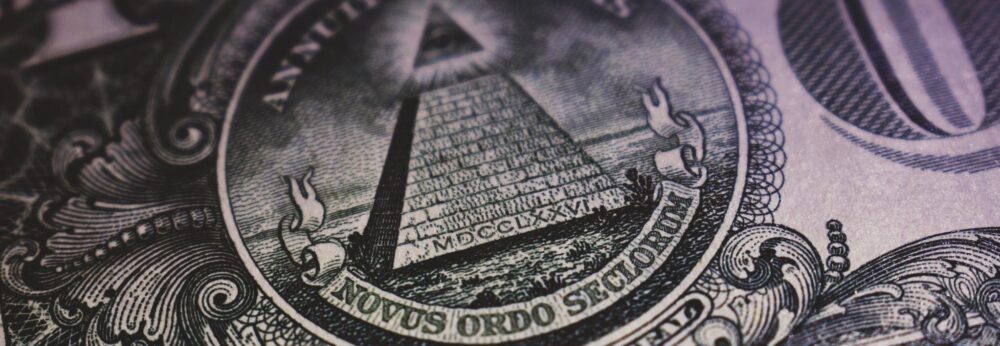
The dangerous symbolism of the Trump coins

Contrary to popular belief, Julius Caesar was not the first living leader to put his portrait on a coin. A couple of others beat him to it, including Persia’s Darius the Great. But the Roman emperor was the first to break with tradition and distribute them to ensure his subjects understood that he possessed absolute power and, not incidentally, controlled the empire’s money supply. It was a savvy move, copied by monarchs and dictators across the world ever since.

America has long followed suit, featuring the faces of our leaders on our currency, but with an important caveat: They had to be long out of power and in their graves. No monarchy or dictatorship for us; we were hostile to the idea of minting the portrait of a living leader for the very reason Caesar thought it was such a clever idea. Our Constitution meant to ensure that no one person in American life would ever have sole unlimited power.

In 1877, Congress even passed a law prohibiting it, which says that “only the portrait of deceased individuals may occur on the United States currency and securities.” Even coins that will be minted for the 250th anniversary of the nation have a special section in the code which states, “No coin issued under this subsection may bear the image of a living former or current President, or of any deceased former President during the 2-year period following the date of the death of that President.”

But that was before we had our own Orange Caesar, who believes he can rule by fiat, supported by Republicans in Congress, and then allow the Supreme Court to sort it out, usually in his favor.

On Oct. 3 it was reported that the Treasury has designed and prepared to mint a new $1 coin with President Donald Trump’s face in honor of the country’s 250th celebration in 2026. The founders would be so proud to know that we made it that far before we finally succumbed to tyranny.

~ Full article…

Is it wrong to have too much money?

Our findings suggest that in countries where inequality is highly visible and persistent, people may adapt by morally justifying their structural economic system, arguing that it is fair and legitimate. In wealthier, more equal societies, people appear more sensitive to the potential harms of excess.

While our study shows that most people around the world do not view excessive wealth as morally wrong, those in wealthier and more equal countries are far more likely to condemn it.

That contrast raises a sharper question: When people in privileged societies denounce and attempt to limit billionaires, are they shining a light on global injustice − or projecting their own sense of guilt? Are they projecting a moral principle shaped by their own prosperity onto poorer countries, where wealth may represent survival, progress or even hope?

~ Full article…

Inside China’s high-tech secret military base known as ‘Mischief Reef’

Mischief Reef, originally a low-tide, ring-shaped island situated in the Spratly Islands—one of the primary archipelagos in the South China Sea—underwent land reclamation around its rim by China starting in the 1990s, with the process largely completed by 2015.

China asserts control over more than 80% of the South China Sea, a waterway rich in energy resources that sees up to $5 trillion in trade annually. The news emerges after it was revealed this tiny island nation is at the center of a secret war between China and the US.

~ Full article…

Tragedy and Hope: Carroll Quigley and the Secret History of Elite Power

Carroll Quigley wasn’t a fringe theorist; he was a highly respected history professor at Georgetown University. He wasn’t peddling outlandish claims; he was presenting meticulously researched evidence. His book, published in 1966, provides a detailed account of what he called an “international Anglophile network,” a transnational group of elites, primarily British and American, who, according to Quigley, exerted significant influence over global events. This network, as documented in Tragedy and Hope, spanned finance, media, academia, and government.

But why all the secrecy? And what was their ultimate goal? Quigley argues that the initial intent was noble: to bring about global peace and stability, particularly in the aftermath of the devastating world wars. However, he also highlights the problematic methods employed, namely, secrecy and manipulation.
[…]
The Tools of Influence: Finance, Media, and Education

The power of this network, as Quigley outlines, relied on specific tools. Finance was a key instrument, allowing for the control of resources and the orchestration of economic events. Media played a crucial role in shaping narratives and influencing public perception. And education, particularly within elite institutions, was the means by which future leaders were trained and socialized into the network’s worldview. Quigley understood the significance of these tools.

“The powers of financial capitalism had another far-reaching aim, nothing less than to create a world system of financial control in private hands able to dominate the political system of each country and the economy of the world as a whole.” – Carroll Quigley, Tragedy and Hope

This is a stark statement. It’s a claim that speaks volumes about the possible motivations of these actors. Could they have successfully shaped global events to their liking?
Is It a Conspiracy?
This is where the waters get murky. Quigley’s work is often misinterpreted, and sometimes unfairly dismissed, as promoting “conspiracy theories.” But he wasn’t simply weaving fantastical tales. He was presenting documented evidence, meticulously researched and presented, of a network of influence. His book, while complex, is hardly a collection of outlandish claims. However, the idea of powerful, unelected groups subtly shaping world events naturally leads to that loaded C-word: conspiracy.

~ Full article…

Carroll Quigley Quotes About Conspiracy

The powers of financial capitalism had a far-reaching aim, nothing less than to create a world system of financial control in private hands able to dominate the political system of each country and the economy of the world as a whole. This system was to be controlled in a feudalist fashion by the central banks of the world acting in concert, by secret agreements arrived at in frequent meetings and conferences.

Carroll Quigley (1966). “Tragedy and Hope: A History of the World in Our Time”, G S G & Associates Pub

~ More…

OpenAI needs to raise at least $207bn by 2030 so it can continue to lose money, HSBC estimates

HSBC’s US software and services team has today updated its OpenAI model to include the company’s $250bn rental of cloud compute from Microsoft, announced late in October, and its $38bn rental of cloud compute from Amazon announced less than a week later. The latest two deals add an extra four gigawatts of compute power to OpenAI’s requirements, bringing the contracted amount to 36 gigawatts.

Based on a total cumulative deal value of up to $1.8tn, OpenAI is heading for a data centre rental bill of about $620bn a year — though only a third of the contracted power is expected to be online by the end of this decade.

~ Full article…

Iceland declares ocean-current instability a national security risk

Iceland’s National Security Council formally labelled the possible collapse of the Atlantic Meridional Overturning Circulation (AMOC) a national security risk in September — the first time the country has applied such a designation to a climate impact.

The move followed a government briefing on new research that raised “grave concerns” about the system’s future stability.

Jóhann Páll Jóhannsson, Iceland’s minister for environment, energy and climate, said the risks extend far beyond weather.

~ Full article…

Italy holds third general strike in three months, against war budget and for Palestine

Italy is on general strike for the third time in less than three months, following a call by the grassroots union Unione Sindacale di Base (USB). Pickets, industrial actions, and demonstrations were organized in over 40 cities, with massive rallies demanding an end to rearmament plans and the war budget shaped by Giorgia Meloni’s government.

On Friday, workers stressed that their mobilization is tied both to worsening material conditions at home and to international events, specifically the struggle of the Palestinian people – whose fate, they insist, is inseparable from Europe’s expanding war economy. As a result, those striking today reiterated their commitment to join the national march for Palestine in Rome, taking place on Saturday, November 29.

~ Full article…

Switzerland has long welcomed the ultra wealthy. A referendum on a new tax has riled them up

Switzerland has long been a haven for the ultra rich. Its 300 wealthiest residents are worth a combined 850 billion Swiss Francs, or just over $1 trillion, according to business magazine Bilanz. But on Sunday, voters will go to the polls to vote on an inheritance tax that has riled them up.

The proposal to tax every inheritance and gift of more than 50 million Swiss Francs at 50% is likely to be defeated. A recent poll put support at just 30%.

But close followers of the debate told CNBC the initiative has shaken wealthy individuals and family-owned companies since it was proposed in 2024. Swiss billionaire Peter Spuhler, founder and owner of Stadler Rail, has threatened to leave the country if the tax becomes law. He told told Swiss daily Tagesanzeiger that his family would struggle to pay such a tax as their wealth is tied up in companies.

~ Full article…

Rockefeller Foundation Partners With MrBeast To Target Youth With “Next-Gen” Propaganda

Dr. Rajiv J. Shah – former USAID administrator and onetime head of agricultural development at the Bill & Melinda Gates Foundation, now president of the Rockefeller Foundation – announced a “next-gen storytelling” partnership with the world’s top YouTube creator, MrBeast.
[…]
Rockefeller Foundation president Dr. Rajiv Shah told AP News that MrBeast can emotionally connect with younger generations in ways that traditional philanthropy has failed to do.

~ Full article…

Spain scrambles to limit damage from African swine fever

The virus does not affect humans but is highly contagious and fatal for pigs, and an outbreak is potentially devastating for the country’s pork industry.

Agriculture Minister Luis Planas said on Saturday the government wanted to limit the economic impact on the agricultural sector “as much as possible”.

Spain, the world’s third largest producer of pork and pork derivatives, exports almost three million tonnes each year to more than 100 countries, Planas told a press conference.

But he said a third of those countries had halted imports from Spain — an automatic safety measure when African swine flu is detected.

~ Full article…